What Would Prove Us Wrong
Every bearish read faces the same fair question: what would change your mind? Ours are published in advance, with the observable that flips each one.

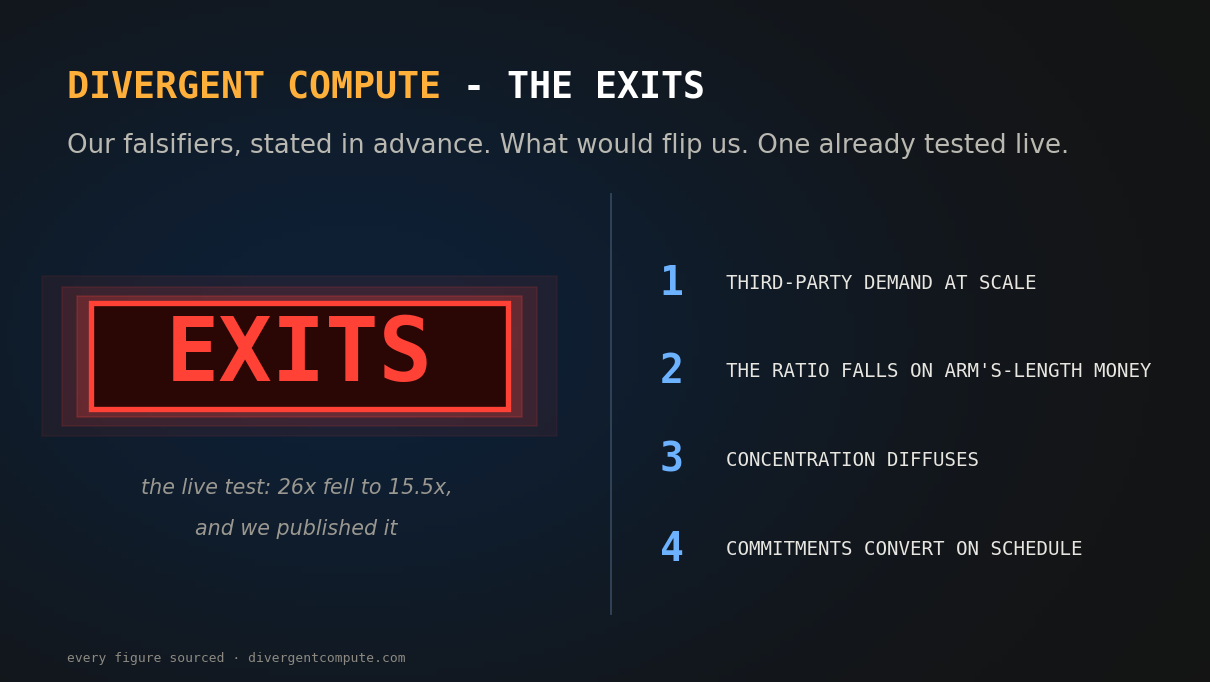
Every bearish read of the AI build-out faces the same fair question: what would change your mind? Most answers arrive after the fact, retrofitted to whatever happened. Ours are published in advance, with the observable that flips each one. This article is the current list — the exits, stated before the trade.
The falsifiers
One: third-party demand at scale. If committed compute is drawn down and paid for out of external customer revenue — buyers outside the investor ring — rather than refinanced by the next equity round, the recycling read weakens at its core. This is the single cleanest refutation, and it would be visible in segment disclosures within two quarters.
Two: the ratio falls on arm’s-length money. If genuinely outside capital enters the labs faster than intra-ring commitments grow, the funded-cash ratio compresses toward an ordinary supplier-financing level. Note the qualifier: arm’s-length. This falsifier had a live test this month — our ratio fell from 26x to 15.5x when we added Amazon’s newly disclosed $15 billion OpenAI stake to the ledger. The falsifier did not trigger, because the new equity came from inside the ring: a top cloud funding the lab committed to its own datacenters. The multiple fell; the circularity tightened. We published the compression anyway, same day, because the number is the number.
Three: concentration diffuses. Today 96 percent of committed lab compute routes to two firms. If that spreads to a competitive set of buyers, the thin-ring fragility eases and we will say so.
Four: commitments convert on schedule. If the multi-year backlogs are drawn and paid on their disclosed timelines — without renegotiation, without fresh vendor financing — the stock-versus-flow objection dissolves and the loop is just business.
And the accounting canary reverses: if the hyperscalers that stretched server lives quietly converge back toward Amazon’s shorter schedule without material earnings damage, the depreciation indicator was noise, not signal.
Why publish the exits
Because a measurement you cannot lose is not a measurement. The desk’s rule is symmetrical: we publish the ratio every quarter regardless of direction, we log every revision on a public, append-only receipts ledger, and when our own headline number was wrong — it was, this week — the correction shipped within hours with the filing quoted.
Being early has a cost, and being wrong has a bigger one. The only honest protection against both is to say, in advance and in public, exactly what the world would look like if the thesis were failing — and then to look, every quarter, on the record.
The list above is the current answer. The filings decide from here.
Each falsifier’s live reading and every dated revision: Falsifier Watch · Receipts